Fashion ·
What the Coat Does to Everything Underneath
A practical try-on sequence for hems, cuffs, shoes and bags, starting with the outerwear you already own.
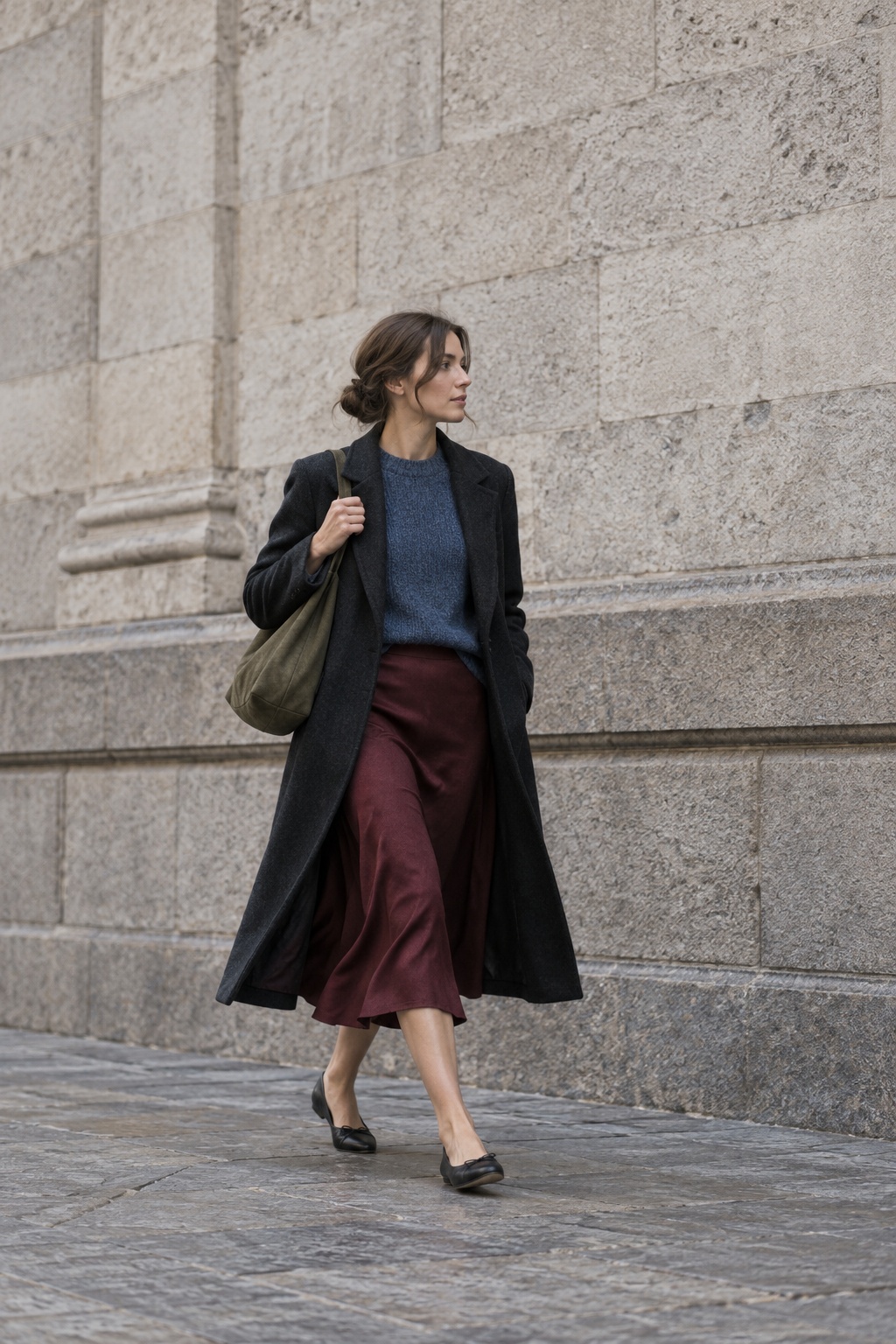
The coat can be perfectly good and the outfit underneath it entirely familiar, yet together they look as though they have only just met. A skirt appears at an uncertain length. A bag presses into the opening. The sleeves become a conversation between three different cuffs.
Outerwear changes the visible relationships between clothes. Close a coat and much of the outfit disappears; open it and the layers become a narrow composition within another outline. The shoes may be the only uninterrupted view of what is happening underneath. That makes the coat a useful starting point for getting dressed, especially when it is the one you already own.
Our preference is to judge the complete arrangement in motion. A hem that looks awkward in a still photograph may become the most interesting part when you walk. A carefully arranged collar may make no sense once you pick up your usual bag. The useful question is which relationships you want to keep seeing through the day.
Begin with the outline the coat actually makes
Put on the layers you normally need, then fasten the coat as you will wear it outside. Look from the front and side. Notice whether the shape comes from the shoulder, the waist, the fall from the back or the space around the body. These observations give you a more exact starting point than calling the coat “oversized” or “classic.”
Shape is built, even when it appears effortless. The V&A's examination of Balenciaga's construction shows how cutting and internal support can organize fabric away from the body. A historical couture garment is a useful lesson in attention, rather than a prescription for how an everyday coat should fit.
For the coat in your wardrobe, notice what happens when it meets the layer beneath. A substantial sleeve inside a narrow armhole may feel crowded; a coat intended to hang loosely may lose the outline you like when belted. Comfort and the garment's own construction should guide the experiment. Do not force a silhouette by tightening a closure or pulling fabric into a position it cannot comfortably maintain.
Choose one configuration to assess first. If you change the knit, shoes, bag and fastening together, you will have little idea which change improved the result.
Decide what the visible hem is doing
A skirt below a coat creates a second horizontal edge. Trousers add another line on the way to the shoe. Neither relationship has a universally correct length. The point is to see the effect and decide whether you enjoy it.
A narrow glimpse of skirt can read as a small interruption; a longer reveal can make the layers feel deliberate. Similar lengths can create a close pair of edges. A much shorter coat over a long skirt produces another arrangement entirely. Try looking at the spaces between these lines, rather than concentrating on the labels or numerical sizes.
Our preferred test is simple: compare the outfit with two existing underlayers of noticeably different lengths. Keep the coat and footwear the same. Walk across the room, turn, sit and stand. Notice whether the hem moves freely, catches in the coat or needs constant adjusting.
If you like a combination only when the skirt is held in a particular fold, it may belong to a photograph rather than your day. A successful everyday arrangement can survive being briefly forgotten. That freedom is part of its visual appeal.
Give the wrist one clear decision
The wrist is a small area where an outfit can become unexpectedly busy. A shirt cuff, knitted sleeve, coat sleeve, bracelet and glove may all try to finish the same line. You need not hide them, but it helps to decide which one you want to notice.
Try a quiet transition first: smooth the underlayer so it sits comfortably, then see what naturally appears beyond the coat sleeve. A narrow piece of colour can connect the coat to another part of the outfit. A generous cuff can become the detail that gives a plain coat character.
These are styling preferences, not a requirement that every sleeve end at a prescribed point. Arm movement, warmth and the coat's cut matter. If the layers pull when you reach forward, changing their visible arrangement will not resolve the underlying discomfort.
Gloves introduce another texture and another practical need. Try them during the test if you expect to wear them. The finished picture should include the things that make the journey possible.
Let the shoes answer the weight above
Under a long coat, footwear can carry a disproportionate amount of the outfit's visible character. A slight shoe beneath a broad shape creates a different balance from a substantial boot. Neither has an automatic claim to elegance.
Begin with what you need to walk in, then compare the options you already find comfortable. Look at the amount of shoe visible, the space above it and whether the trouser or skirt hem moves cleanly. You are choosing a relationship, rather than correcting a supposedly wrong body proportion.
Colour can help you make that choice. A shoe that repeats a darker line above may create continuity; a contrasting one can give the outfit a distinct endpoint. We favour a contrast when it looks intentional and remains pleasing from the side, where the coat's volume may be more apparent.
Do the walking test on a safe surface and for the activity you are planning. An attractive silhouette is a limited achievement if the shoes make you change how you move.
Add the bag before calling the outfit finished
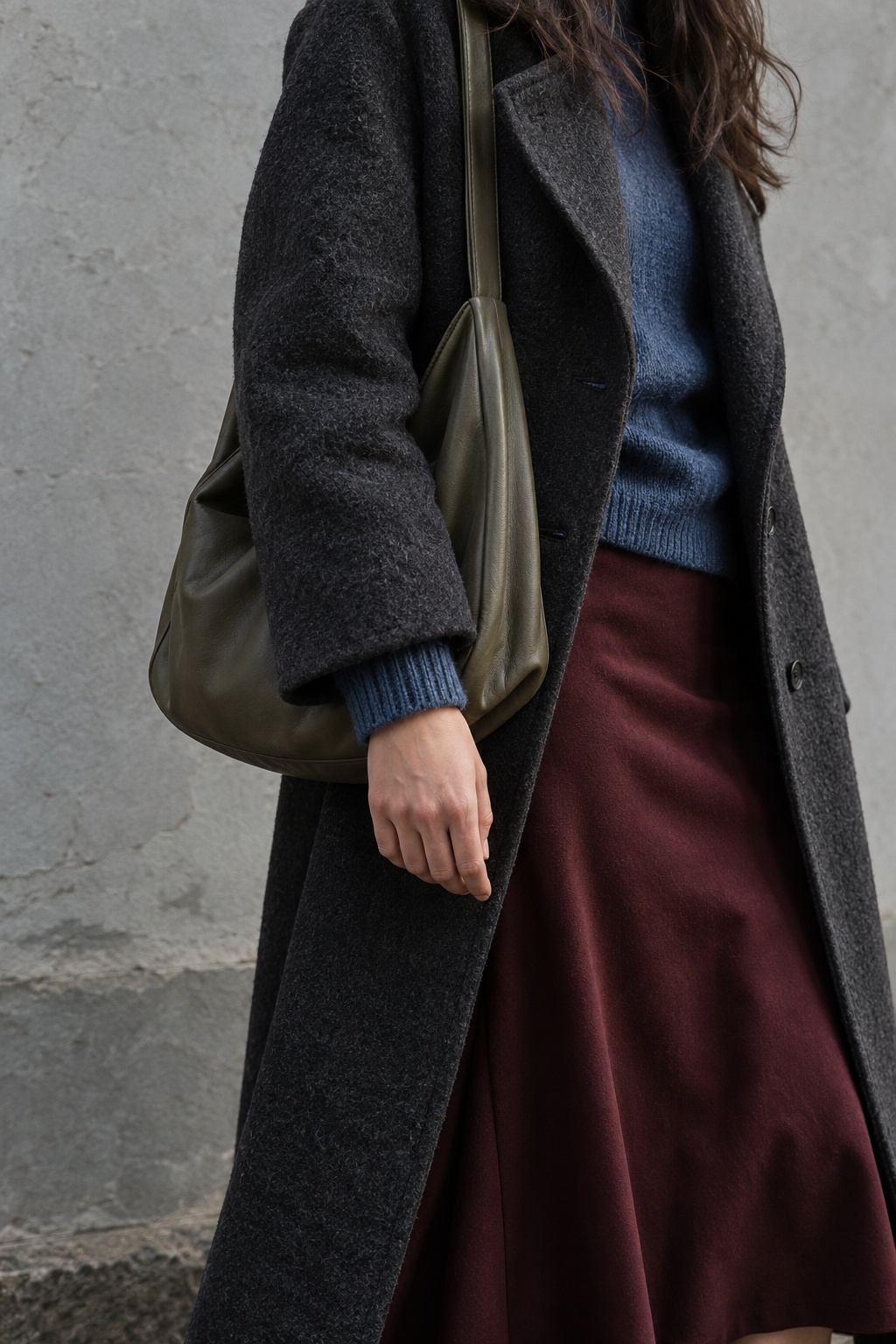
A shoulder strap can draw a diagonal across a coat, compress a collar or pull an opening off centre. A bag at the hip can meet the widest part of the silhouette. These are visible features of wearing it, so include the bag while making the decision.
Load it as you normally would. Try the position you actually use, rather than the one that looks best for a moment in the mirror. If the coat closes easily without the bag but becomes awkward with it, a different carrying position may help. If it does not, another bag you already own might be the easier answer.
The same principle applies to a scarf. Add it after you understand the larger outline, then see whether you want the neckline fuller, simpler or more open. Our scarf guide considers those smaller changes; the everyday-bag guide starts with what has to travel with you.
Keep the combination that survives leaving
Before changing anything else, fasten the coat, open it, sit down, reach for the bag and take a few steps. Check the version you will wear in transit as well as the one you reveal indoors.
You may discover that the improvement is modest: a different sweater, the skirt you had forgotten, less fabric at the neck. That is a useful result. The coat has helped you see a relationship between clothes that were already there.
The best combination does not require every edge to agree. It gives the eye something clear to follow, then lets the wearer get on with the day.