Capital ·
What your first clothing collection really costs
Before placing an inventory order, bring quantity, landed cost, launch work and available cash into one calculation. Start with TAC’s free calculator.

A first collection becomes tangible in pieces: a fabric swatch, a sample, a factory quote, a rail that finally looks like the beginning of a brand. The price per garment can feel like the number that makes the whole thing possible. It is also a number that needs company.
Before committing to an order, put that quote beside the quantity, the cost of getting the garments to you, the packaging, and the work needed to make the collection ready to sell. The useful question is concrete: how much cash does this particular plan require before its first sale?
We built the free First Collection Cost Calculator to make that first calculation easier. You can use it without buying a TAC product. Start with your current estimates, see what they imply, and return when a quote changes.
Put the whole order next to the unit price
A production quote tells you something specific. Check what that price includes and what remains yours to arrange. Fabric, trims, labels, packaging, freight and duty should each have a clear home in your working figures. A low-looking unit price is difficult to interpret while its exclusions are still scattered across messages.
The calculator uses three inputs to build landed cost per unit: production, freight and duty, and packaging. It multiplies their combined amount by the units you plan to order. That gives you an estimated inventory commitment. Fixed launch costs then sit alongside the order rather than disappearing into an optimistic per-garment calculation.
The relationship is straightforward: estimated cash required = fixed launch costs + planned units × (production + freight/duty + packaging per unit). These are the categories in this particular tool. Check that you have included the costs relevant to your own plan and avoided entering the same expense twice.
Give the work before selling its own line
Sampling, product photography, an ecommerce setup and other launch work can involve costs that are not represented by the number of garments in the order. Enter the relevant fixed costs as a total, using figures you can explain. Keep a separate working list showing what sits inside that total, what has been quoted, and what remains an estimate.
This is a useful distinction even when an expense is paid in stages. The free calculator estimates the combined requirement; it does not build a payment calendar. A deposit and a later balance may divide a commitment across dates without changing its total. You still need to know when each amount is due.
If a cost is unknown, name the uncertainty in your working notes. An unquoted shipping charge should not become a confident zero. The purpose of the first pass is to expose the questions worth taking back to a supplier or service provider while there is still time to change the plan.
Read the cash difference carefully
The calculator compares the modeled requirement with the cash you enter. A positive difference means that cash exceeds the costs included in that calculation. A negative difference shows the additional cash those entered assumptions require. Neither result establishes that the collection will sell.
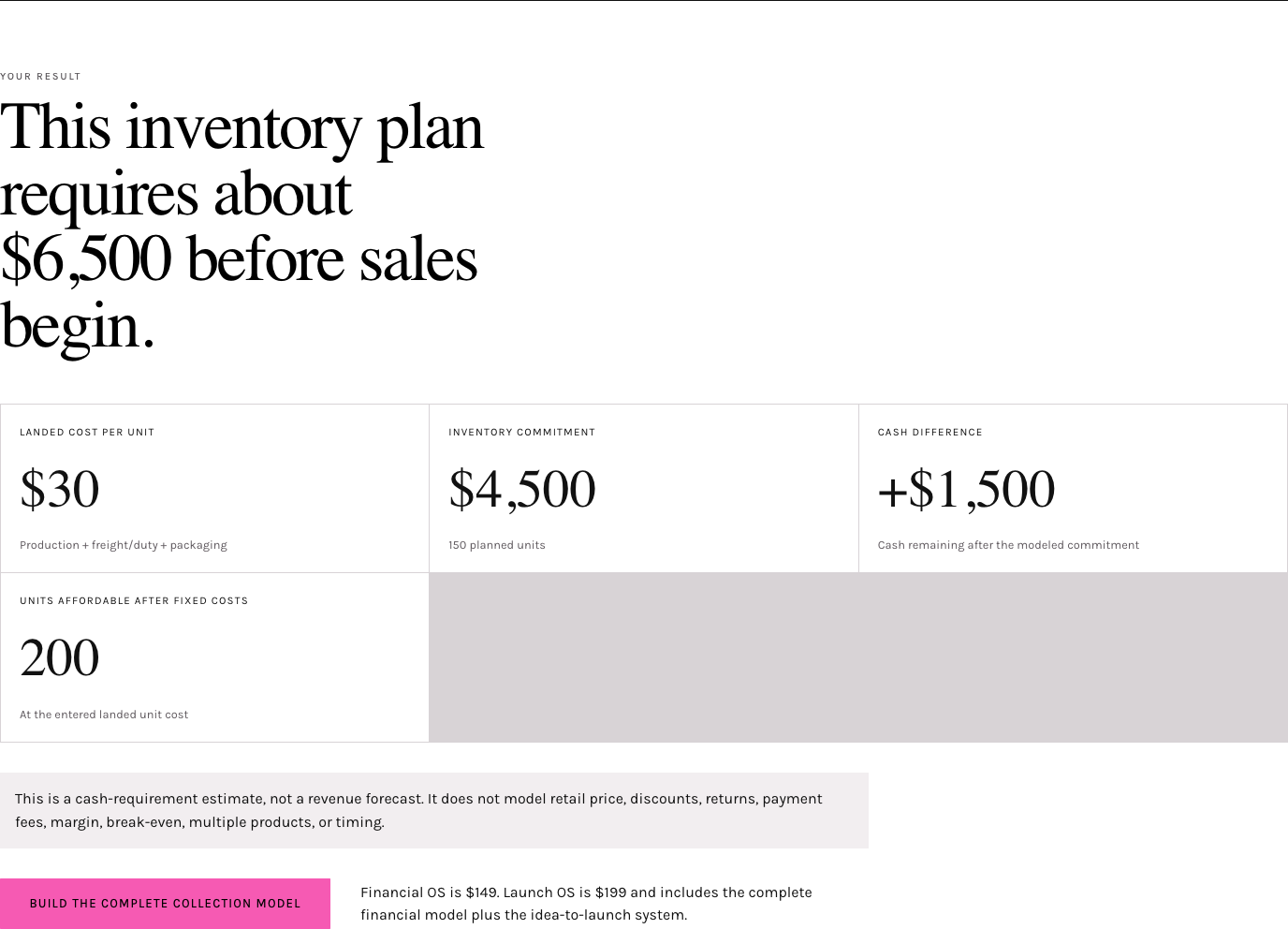
The example pictured here is a demonstration, not a customer case or a suggested launch budget. With $8,000 available, $2,000 in fixed costs, 150 units, $24 production, $4 freight and duty, and $2 packaging per unit, the landed cost is $30. The inventory commitment is $4,500. Adding the fixed costs gives a $6,500 requirement and a $1,500 difference against the entered cash.
Those figures demonstrate the arithmetic only. They do not establish current manufacturing prices, a suitable order size, or sufficient operating reserves. Replace every input with your own evidence. Try the calculation with your figures.
Change one assumption, then look again
The most useful result may be the second one. Change the quantity while holding the entered unit cost steady and see what happens to the commitment. Then ask whether that unit cost would actually remain available at the smaller quantity. The calculator does not renegotiate the quote for you.
Try a more complete freight estimate or a different packaging cost. Watch which assumption changes the cash requirement most. This is a way to make a question visible before accepting an order, rather than a reason to select whichever inputs produce the most comfortable result.
A smaller first order can reduce the commitment within a model, but suitability also depends on supplier terms, product requirements and demand evidence. The tool cannot decide those questions. A garment rail shows the collection's physical scope; the calculation shows the financial scope of the assumptions you have entered.

Carry the estimate into a wider collection model
One average product is a useful beginning. A collection with several products, different costs or different quantities needs more detail. A jacket and a T-shirt should not become interchangeable simply because an average makes the first estimate easier to read.
The free calculator does not model retail price, discounts, returns, payment fees, margin, break-even, multiple products or cash timing. A cash difference is therefore not profit, and an affordable modeled quantity is not a demand forecast. Keep the distinction visible when sharing the result with anyone else.
TAC's paid First Collection Financial OS adds a multi-product collection model for the wider economics. Launch OS includes that model and connects it to customer evidence, collection scope, production, operations, route to market and launch dependencies. Compare the two systems. The free calculation stands on its own if that is the question you need to answer today.
Before you commit
Gather the quote, its exclusions, the proposed quantity and a clear list of fixed launch costs. Calculate the requirement. Write down what remains unknown. Then decide which assumption needs a better answer before the order moves forward.
The aim is to see the commitment clearly enough to question it. A finished sample can make an idea feel ready; a useful model shows the work and cash still required to carry that idea into a first collection. Start with the free calculator.