Capital ·
Who is placing the order?
Fashion has plenty of material breakthroughs. The less glamorous question is who will buy enough, for long enough, to make them part of an ordinary collection.
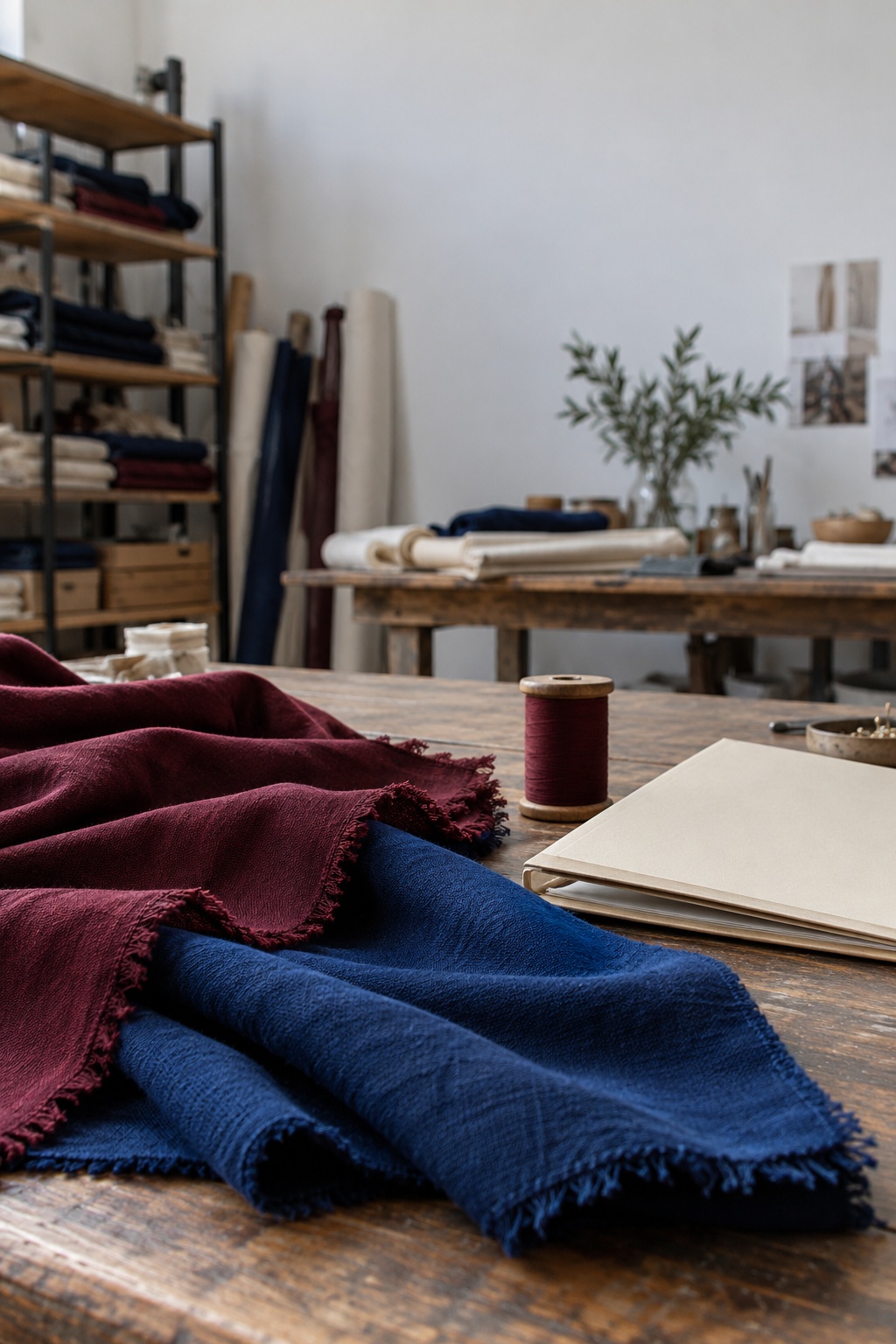
The exciting part of a new fashion material is usually easy to photograph, while the decision that could secure its future is considerably less photogenic. A striking sample gives the story an object. A dress gives it movement. A famous wearer gives it an audience. Somewhere behind those images, however, somebody needs to decide how much material to order, what it must do, when it must arrive, and whether the company will want it again. That decision deserves a little more of the spotlight.
It is the reason a purchasing announcement can be as interesting as a runway debut. On September 23, 2026, Amazon announced the Climate Pledge Fashion Coalition, alongside Stella McCartney and Canopy, with convening support from the World Economic Forum. The announcement describes a network of more than sixty fashion-related Climate Pledge signatories and an effort to align demand with financing for new materials and production processes. It establishes an initiative and its proposed approach. It does not establish that sixty companies have already placed binding orders.
That distinction is where the useful story begins. Fashion’s enthusiasm for innovation becomes more meaningful when we can follow it into the arrangements that allow the innovation to be made again.
A sample is a beginning
Imagine a material that works beautifully in a prototype jacket. The designer likes its weight, the finish suits the silhouette, and the sample photographs well. Now imagine the same material arriving late, varying between batches, or being available only in a quantity that the collection cannot use. Nothing in that hypothetical sequence means the original idea was bad. It means a successful sample and a dependable production material answer different questions.
This is why “ready” needs an object after it. Ready for an experiment? Ready for a small collection? Ready to be reordered across several seasons? A material can reach one stage while still needing work at another. Treating the first convincing garment as proof that all the remaining questions have been settled makes it harder to understand both the achievement and the challenge. The prototype deserves credit for what it demonstrates, with room left for what production still has to establish.
Canopy’s account of the coalition identifies a specific obstacle: producers want evidence of demand before they invest in capacity, while one brand may be unable to provide enough of that evidence alone. The proposed response is collective demand and shared knowledge. In ordinary terms, a supplier needs more to plan around than several companies independently saying that a sample is interesting.
Consider the difference between compliments and a calendar. Compliments say the work has potential. A calendar connects quantities, delivery dates and repeat needs. It allows the parties to discuss what has to happen before those dates can be met. The attraction of coordinated purchasing is that it could make such planning more credible. Whether a particular initiative achieves that depends on what its participants actually agree to do.
Read the verb before the number
The language around a coalition matters because participation can describe very different levels of commitment. Joining a group, setting a target, expressing interest and signing a supply agreement should not be compressed into the same accomplishment. Each might be useful, but each leaves a different amount unresolved. A large membership figure tells us who is in the conversation. It cannot, by itself, tell us how much material will leave a factory.
A separate initiative makes that range unusually visible. The Fashion Pact and Fashion for Good’s Circular Fibre Collective describes voluntary demand aggregation and individual non-binding commitments. This is a separate initiative from the Climate Pledge Fashion Coalition. The comparison is useful because a non-binding expression of demand cannot be read as a completed purchase. The next stage needs evidence of what buyers have actually agreed to do.
For a reader, the next questions are concrete. Does the announcement specify quantities and a period of time? Are the commitments conditional? Does it identify which stage of production is being supported? If those details are absent, the honest conclusion is that the public evidence does not yet answer them. That is different from assuming nothing is happening. It is also different from treating an ambition as a delivery receipt.

Scale still has to leave room for design
There is a fashion question here as well as an industrial one. A material should earn its place in the garment through what it allows the designer to do. Does it hold a shape, collapse into a fold, take color, catch light, or withstand the intended use? The answer will differ between a tailored jacket and a fluid evening dress. “Alternative” describes a relationship to another option; it does not describe the aesthetic result.
Shared purchasing could give designers access to choices that would otherwise remain difficult to obtain. It could also create pressure to work around a narrower set of specifications. Those are possibilities to examine, not outcomes these announcements have already demonstrated. The interesting test is whether a more dependable supply produces more room for interpretation. Several designers using the same material need not make the same garment, just as a shared vocabulary need not produce the same sentence.
The wider system also matters. In its September 2026 fashion and textiles update, the Ellen MacArthur Foundation identifies materials, business models and infrastructure as connected barriers. Collection, sorting and recycling capacity cannot simply be assumed to exist because a product is described as circular. Its proposed 2040 agenda is scheduled for publication in early 2027. That is work in development, rather than evidence that the system has already changed.
A new material’s environmental case deserves the same specificity as its commercial case. A statement about its feedstock does not answer every question about processing, use or eventual disposal. Likewise, purchasing more of something does not itself prove that the material it was meant to replace is being used less. A useful assessment asks what changed, compared with what, and on what evidence. Those questions can support promising work without granting every innovation the same automatic endorsement.
The next time a breakthrough arrives in your feed, enjoy the object and then look for the order behind it. Who has committed, what are they buying, and how will anyone know it was delivered? The material’s future will become much easier to judge when the announcement can answer those questions as clearly as the photograph answers what it looks like.