Culture ·
This shop shows its working
At Potato Head’s Good Times General Store in Bali, the dye studio belongs beside the merchandise. That changes what a retail room can ask us to notice.
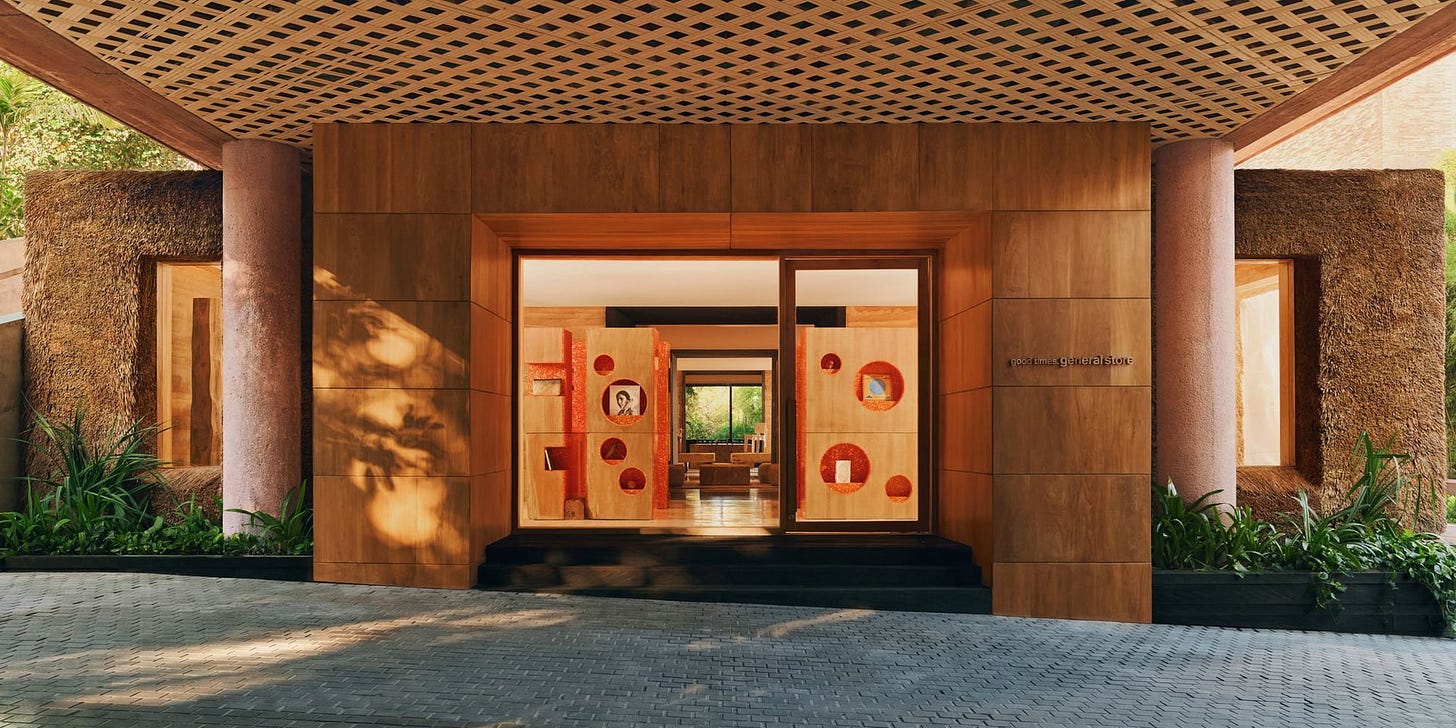
A shop usually lets the finished object make the introduction. The chair has found its place. The shirt is ready to wear. Whatever happened to the material before it reached the shelf can be compressed into a label, if it appears at all. Potato Head’s Good Times General Store proposes a different arrangement: the space for making is part of the place where things are offered for sale.
Designed with OMA at Desa Potato Head in Seminyak, the store brings clothing and objects into a sequence that includes a natural-dye studio and a workshop. Potato Head’s own description identifies five bays, moving between independent makers, its in-house collection, the Wasted collection developed with Max Lamb, and spaces devoted to process. It offers a real room through which to consider an appealing retail promise: understanding more about an object before taking it home.
Recent design coverage has brought the project into view. That coverage is the timely reason for looking here; it should not be confused with evidence that every part of the programme opened this week.
The outside introduces a material conversation
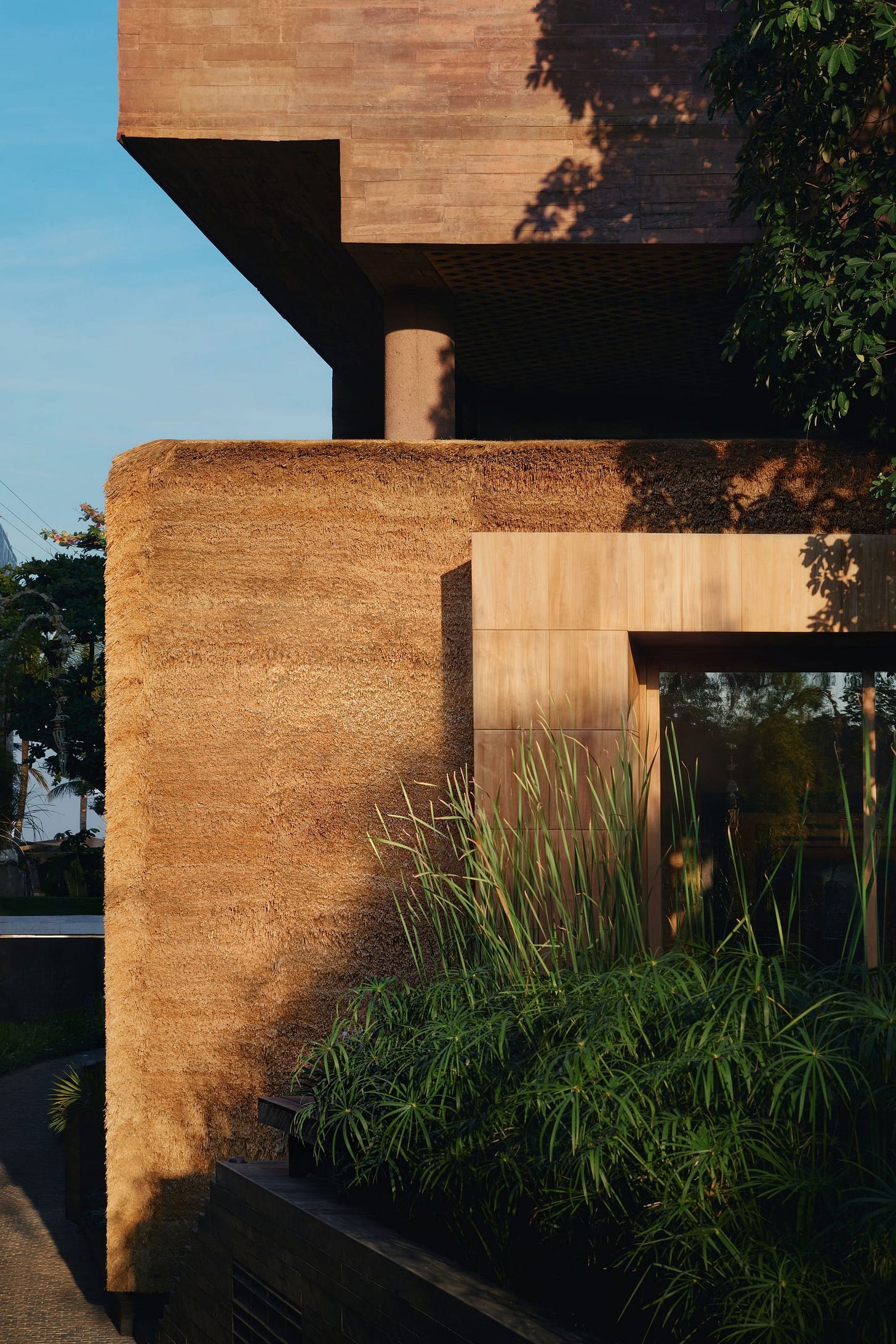
In Wallpaper’s October 20 account, roofing thatch becomes an exterior finish, while rammed-earth walls reveal different surface treatments. The photographed structure sits in relation to the much larger concrete architecture around it. Those differences give the eye something more interesting than a single consistent idea of natural warmth.
The appeal is in the relationship. A rough surface looks different beside a precise opening. A fibrous exterior reads differently beneath a substantial concrete structure. Material character becomes easier to notice when the neighbouring surface gives it a useful comparison.
That is a design observation, rather than an environmental verdict. Thatch, earth or a recycled-looking object cannot establish a building’s full impact through appearance alone. The useful first task is to describe what the material does in the room: how it organizes attention, marks an edge or changes the feeling of the object beside it.
A retail interior has particular power over those judgments. It can make a small item seem precious, ordinary, experimental or reassuring before anyone has picked it up. The architecture participates in the value story. Taking that participation seriously means asking what the setting helps us understand, as well as enjoying what it makes us want.
Five bays create more than a product sequence
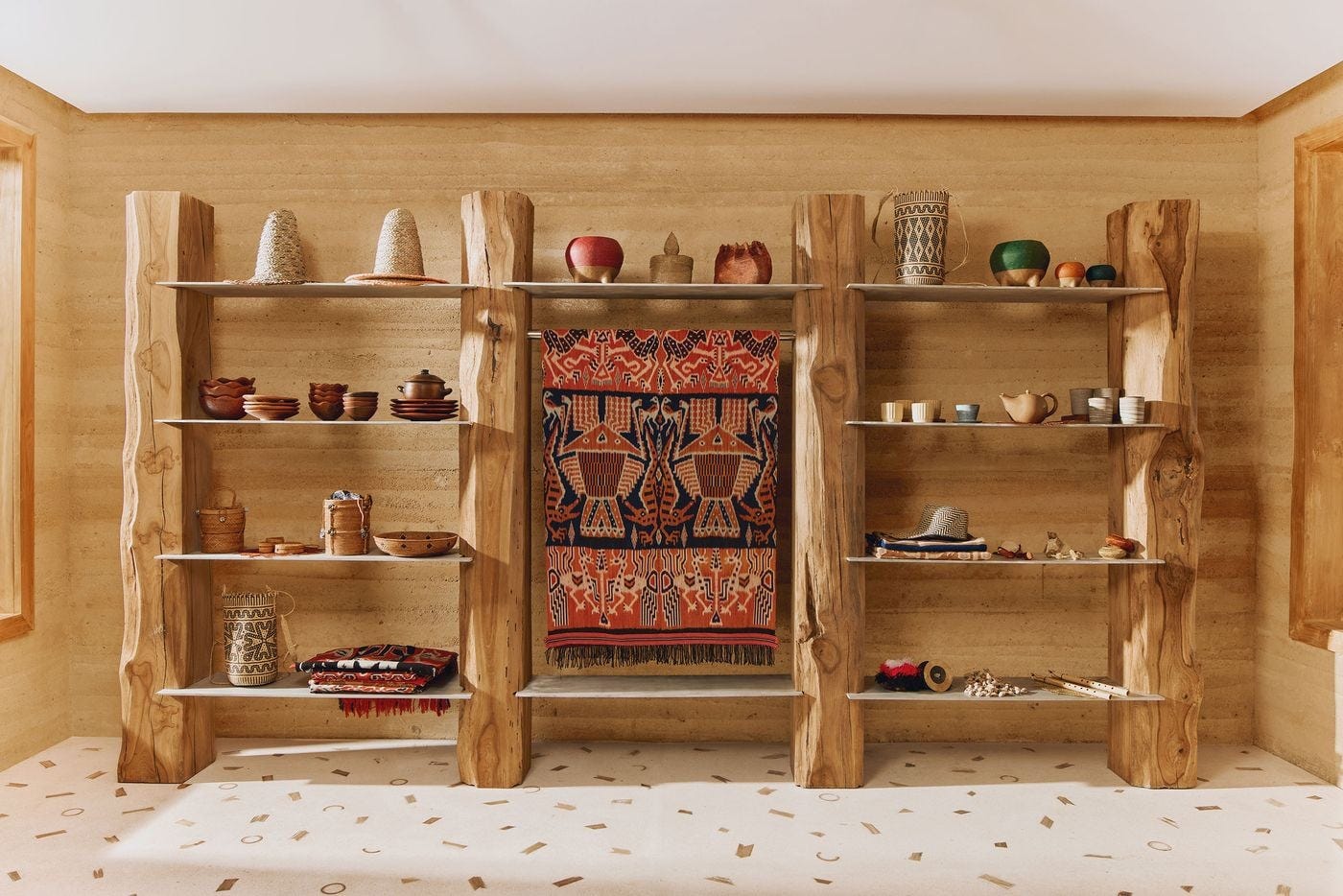
The store’s arrangement gives different forms of work neighbouring addresses. The souvenirs section includes objects, books and records from independent makers. Another bay holds Potato Head’s apparel and travel pieces. Wasted gives discarded material a role in furniture and homeware. The remaining spaces turn attention toward dyeing and experimentation.
The distinction matters because a finished item and a process offer different kinds of evidence. An object lets us examine the result. A studio can help explain a transformation. Neither automatically supplies the other’s account: a compelling demonstration does not tell us everything about a product, and a polished product does not reveal every decision behind it.
There is also pleasure in discovering that colour can have an origin worth following. The store describes a dye studio working with plants, food waste and minerals. Rather than treating a colour as a purely visual preference, that description invites a question about what produced it. The question can make an ordinary surface more particular without requiring every visitor to become a textile specialist.
An invitation to learn does not need to end in a purchase to have value. A person might leave with a better understanding of a material or a name to investigate. The educational part of the room becomes more convincing when those possibilities are allowed to remain worthwhile in their own right.
A workshop needs its own timetable
A flexible making space can suggest a much fuller programme than is operating on the day a photograph is taken. The distinction belongs in an account of this project. Yatzer’s recent report describes further weaving, upcycling and sewing workshops as due to join in 2027. The natural-dye programme already has its own public listings. The whole future programme should not be described as though every element is available now.
This is a useful discipline for design criticism more generally. Architecture can make an activity possible without proving how often it happens, who participates or what they learn. A movable table can support different uses. It cannot establish a successful educational programme merely by being movable.
The interesting follow-up will concern the relationship between the room and the people using it. Does the workshop help someone understand the object they were considering? Can a local maker’s knowledge become more visible through the encounter? What information remains available when the visitor has gone home?
Those questions are not objections to the design. They explain what would make its promise more substantial over time.
Participation is not the same as buying less
The phrase “post-consumption retail,” used in the project’s coverage, is provocative precisely because this remains a shop. Objects are offered for sale. The fact that visitors may also make, learn or spend time there does not demonstrate that they purchase fewer things or that total material use falls.
The more persuasive proposition is smaller and easier to examine. A retail encounter can make production more legible. It can put a material transformation near the product that asks us to value it. It can allow the maker’s work to become a subject of attention instead of supplying anonymous atmosphere.
That offers a demanding standard for any beautiful store. Does the setting sharpen our understanding of the objects, or lend them a flattering backdrop? Are the sources and processes particular enough to follow? Can the visitor carry something useful away even without acquiring the thing on display?
Good Times General Store is interesting because its physical organization makes those questions visible. The studio is not merely a story written on a tag. It occupies space beside the merchandise. Whether that proximity delivers the full cultural and environmental ambitions described for it remains a matter for evidence and continued use.
For now, there is a concrete design achievement to look at: a shop has given some of its valuable floor space to the work behind the object. The next question is what that work is allowed to teach us.