Capital ·
When the fashion archive gets a bid button
A beautiful old dress can teach you something before it becomes something you want to own. The difference matters.
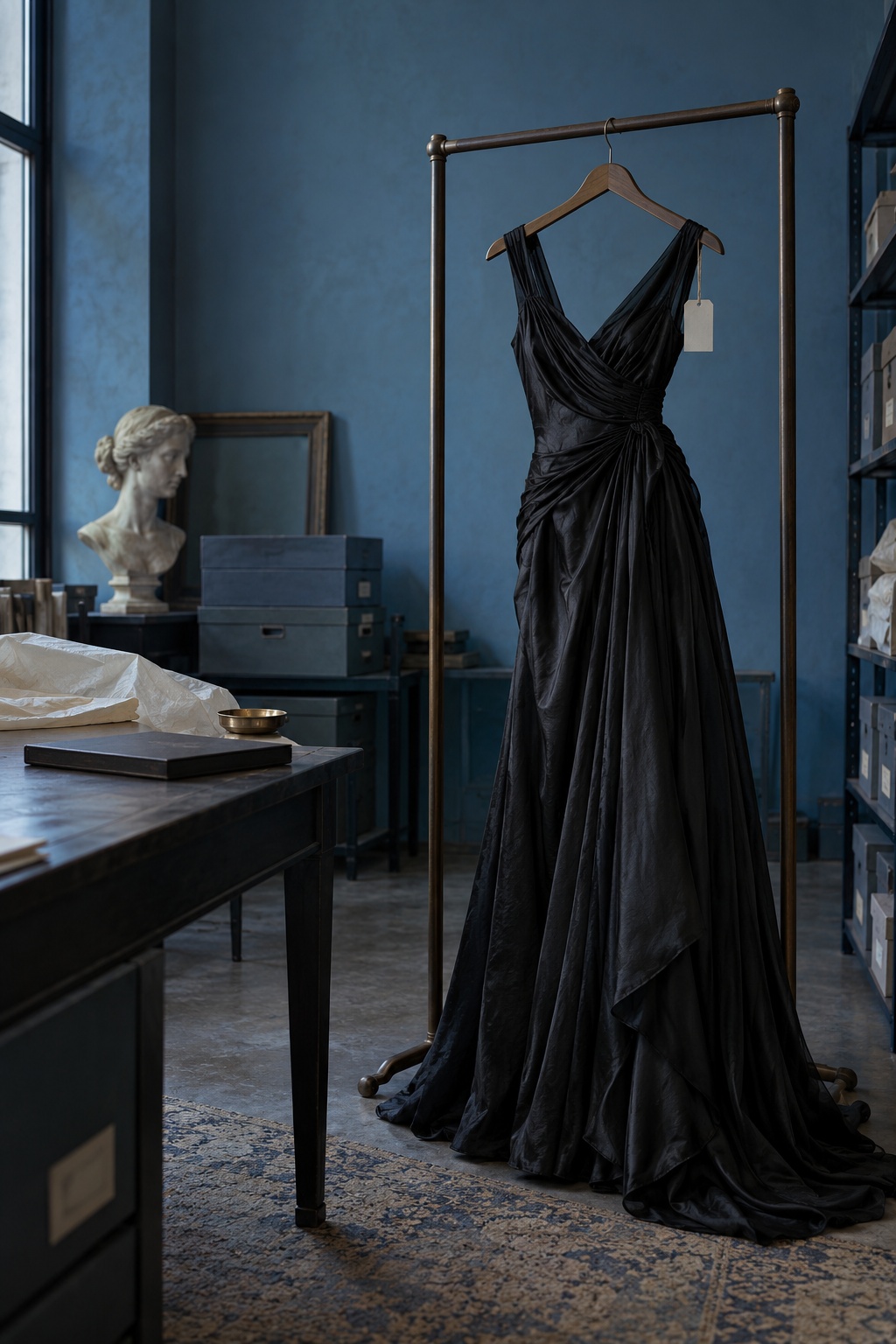
A dress becomes unusually persuasive when the invitation to learn its history arrives beside the invitation to take it home with you. Suddenly the date, designer, and previous appearance do double duty: they explain the object and make a case for wanting it. There is nothing automatically dishonest about that combination. It does, however, deserve a little more attention than the familiar promise that shopping has become an education.
The September announcement for eBay and the CFDA’s Endless Runway: The Archive described an exhibition curated by Carlos Nazario, bringing together more than 150 rare and archival American fashion pieces. An accompanying live auction hosted by Jenna Lyons was scheduled for September 9, with proceeds benefiting the CFDA. Listed highlights included a Calvin Klein Collection dress from spring/summer 1996 and a Willy Chavarria gown from spring/summer 2025. Those details describe the announced programme, rather than establish the auction’s results or the garments’ eventual destinations.
The interesting proposition is that discovery, interpretation, and purchase can happen inside the same encounter, with very little friction between one activity and the next. You can arrive curious about American fashion and leave wondering whether you have just missed your chance to own its best example. That movement is the subject here. A compelling introduction to history can also be a very effective way of arranging desire.
A price answers a particular question
An auction result records what a buyer agreed to pay under particular conditions, which makes it useful information with a surprisingly specific boundary. It cannot, by itself, tell us how consequential a garment was to the people who wore similar clothes, how influential its construction became, or how much of its original context survives. Those questions require different kinds of evidence. The person with the winning bid has bought the object, not the final word on its meaning.
Consider the distinction between a garment that photographs beautifully and one that reveals something important when its lining is turned outward for closer study. The first may be easier to explain in a quick image; the second might disclose alterations, economies, or decisions that change how we understand its making. This is a hypothetical comparison, not a claim about the lots in this particular auction. It is a useful reminder that visibility and historical usefulness need not arrive in the same proportions.
The temptation is to let commercial excitement settle the matter because a number feels more definite than a discussion about influence or everyday life. But a high price is not an essay, and a low price is not a historical dismissal. Fashion becomes less interesting when the clothes that sell most dramatically are allowed to stand in for everything that mattered. We should be able to admire a spectacular sale while keeping quieter objects inside the conversation.
The record deserves its own spotlight
The apparently modest information in an object record can do more for a reader than an elaborate claim that something is iconic or collectible. A date range, material, accession number, and acquisition credit create points that another person can follow, question, or compare. For example, the Met’s record for a pair of American silk stockings gives a date range of 1875–1925 and records their donation by Mercedes de Acosta in 1940. The museum also identifies them as not currently on view.
That entry does not make the stockings a complete history of dressing, but it gives the object an identity that persists beyond a dramatic reveal. A reader can distinguish what is recorded from what remains unknown. The broad date range is especially useful as an example of honest incompleteness: precision is valuable when the evidence supports it, and uncertainty is valuable when it prevents us from pretending to know more than we do.
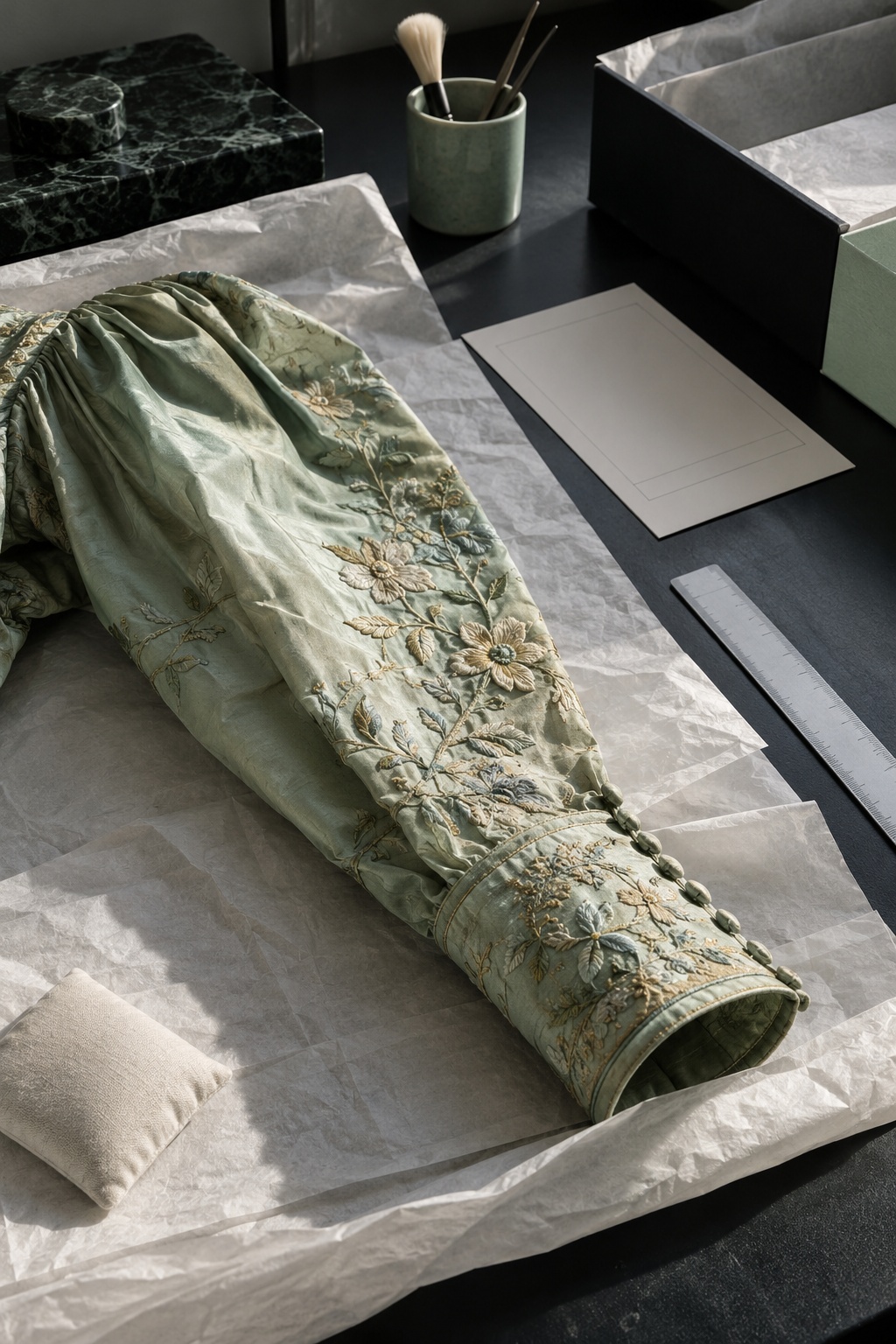
A commercial archive can be judged by a similar practical question without requiring it to become a museum or abandon the business of selling. Does the object’s documentation remain accessible after the sale? Can a student return to the measurements, construction images, and attribution? Is the condition described with the same care as the glamorous association? These are standards worth asking for, rather than claims that any particular platform has already met or failed them.
Access has more than one meaning
The word access becomes slippery when it describes both the ability to encounter fashion history and the ability to compete for ownership of it. Seeing a garment, understanding it, studying it, trying it on, borrowing it, and buying it are different experiences. A programme may improve one while doing very little for another. Calling them all access makes a generous-sounding promise harder to evaluate.
The International Council of Museums’ definition places research, conservation, interpretation, public accessibility, and community participation within a museum’s responsibilities. A marketplace has a different purpose, and it would be unreasonable to pretend the two institutions are interchangeable. The useful comparison concerns what remains available to people who cannot or do not wish to become buyers. An encounter with history should be allowed to produce knowledge without requiring a receipt.
The best commercial presentation, in this reading, leaves something behind for the person who closes the page without buying a single thing from it. That might be a clearer account of a technique, an accurately identified maker, a construction detail, or a reason to reconsider an overlooked designer. These outcomes do not cancel the sale. They give the educational promise something concrete to stand on beyond the excitement of proximity.
Enjoy the treasure hunt, keep your questions
Collecting can be a serious expression of curiosity, and the desire to live with a beautiful object does not disqualify someone from understanding it. Nor does institutional ownership automatically provide the richest possible account of a garment. The distinction worth preserving concerns what each setting allows us to know, what it asks us to value, and which parts of the story disappear when the encounter ends.
For anyone browsing archival fashion, a useful habit is to separate the reasons an object interests you from the reasons its seller says it matters. You might love the proportion, the colour, the eccentric fastening, or the way a familiar silhouette has been made unfamiliar. Keep those observations. Then examine the date, attribution, condition, and history on their own terms, without asking the pleasure of looking to substitute for evidence.
The Criterion: a fashion archive becomes more useful when its knowledge can travel farther than its objects, giving curious people something lasting even when somebody else wins the bid. Enjoy the theatre of discovery, but notice whether the information survives the performance. A beautiful old dress can be both desirable and instructive. The second quality should not depend on your ability to pay for the first.