Culture ·
Eclectic Living Room Ideas: How to Mix Vintage, Modern, Color, and Art
The best eclectic living rooms do not contain the most things. They make different periods, colors and objects answer one another—then leave enough quiet for those relationships to be seen.
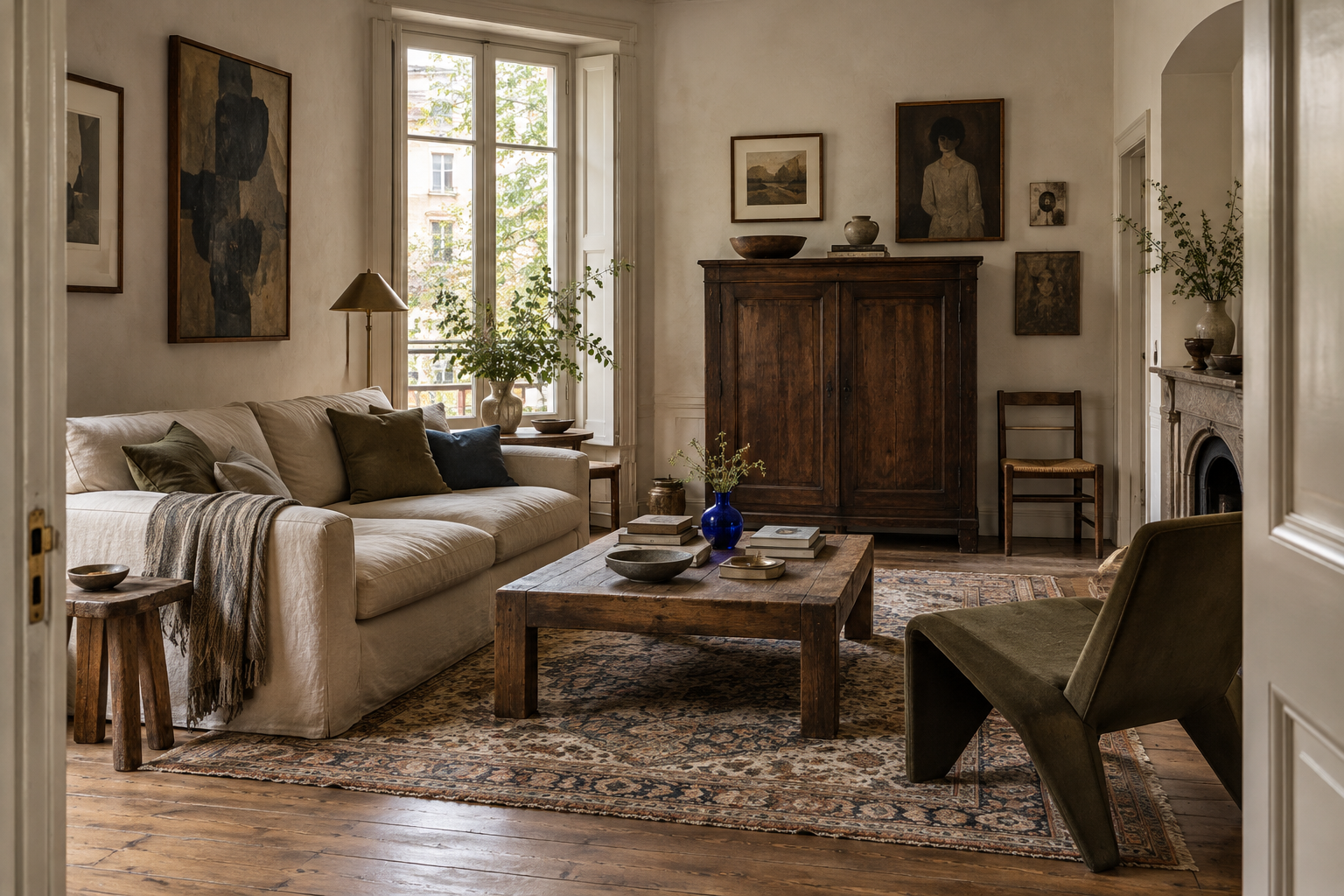
An eclectic living room can be full without feeling crowded, colorful without feeling juvenile, and historical without becoming a period set. The distinction is not the number of objects in the room. It is whether those objects have a relationship to one another.
That is why collecting more inspiration often fails to solve the problem. A saved room gives you its finished appearance, but not the sequence of decisions that made it coherent. You can copy the sofa, lamp and gallery wall and still miss the thing holding them together.
The more useful principle is simple: contrast needs a hierarchy. One visual idea leads. Other pieces repeat it, answer it, soften it or interrupt it. Once that hierarchy is visible, old and new can coexist without an arbitrary formula.
Begin with the room, not the aesthetic
Before deciding whether the room should be “modern eclectic,” “vintage eclectic” or anything else, read what is already there.
Start with five facts:
1. Where does the natural light enter, and what changes after dark? 2. Which route through the room must remain clear? 3. Which piece has enough size, color or material weight to lead? 4. What is staying because it is useful, loved, inherited or expensive to replace? 5. Which objects are performing the same visual job?
That last question is especially revealing. Three small side tables, five timid accent colors or a wall of similarly sized frames can create noise even when each object is attractive. An eclectic room does not need every object to be unusual. It needs different objects to do different jobs.
Try three changes before buying anything: remove one duplicate, move one piece closer to the object it should converse with, and increase the empty space around the strongest item. Photograph the room after each move. The goal is not to make it finished; it is to make its structure easier to read.
Choose one lead voice
The lead may be architectural—a dark fireplace, a run of windows, a striking floor. It may be an old armoire, a large artwork, a rug or a decisive wall color. What matters is that the eye can find it.
Once the lead is named, every other object can be given one of three supporting roles:
- Repeat: echo a line, color, material or level of visual weight. - Relief: offer quiet space, a paler value or a simpler silhouette. - Interruption: introduce one controlled surprise that keeps the room alive.
A dark cabinet might lead. Slim black frames repeat its vertical lines. A pale linen sofa gives relief. A cobalt vase interrupts the brown and olive ground. The pieces do not match, but their jobs are legible.
Mix vintage and modern furniture through relationships
There is no correct vintage-to-new percentage. A room with one old cabinet can feel more grounded than a room containing six anonymous “vintage-inspired” pieces. Age is not the composition.
When two objects from different periods feel unrelated, compare six things:
- silhouette; - line; - material; - finish; - scale; - visual weight.
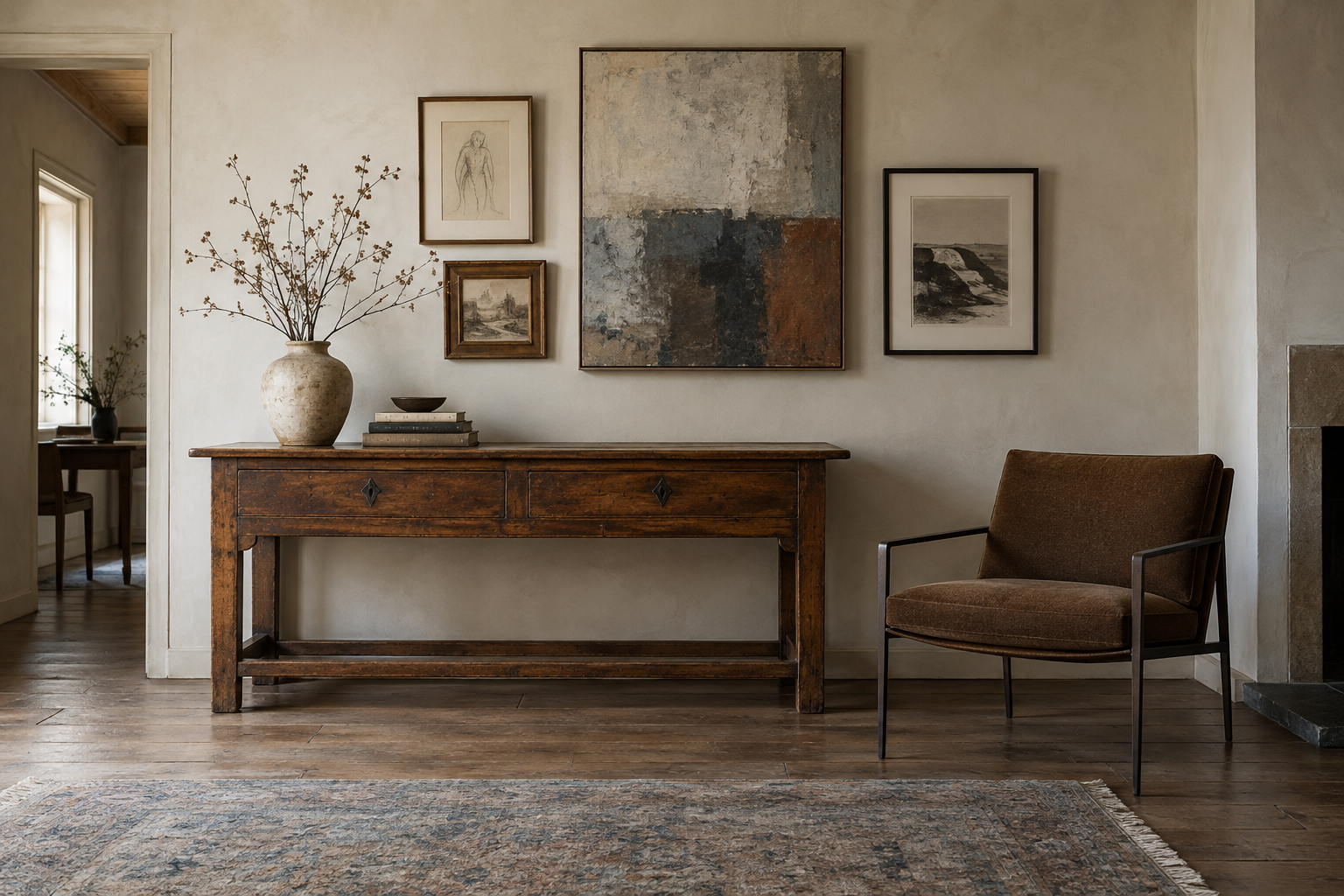
They do not need to agree on all six. Two agreements are often enough. A carved wood console and a spare steel chair may share a low horizontal proportion and a dark visual weight, while differing in age, finish and construction. The contrast then looks deliberate rather than accidental.
Avoid solving every difference with a coordinating accessory. The pillow that repeats the rug, artwork, chair and vase can become proof that the room is trying too hard. Let some objects relate through shape, spacing or material instead of color.
Use color as structure
Color becomes chaotic when every shade asks for equal attention. A more reliable approach is to separate color into three levels:
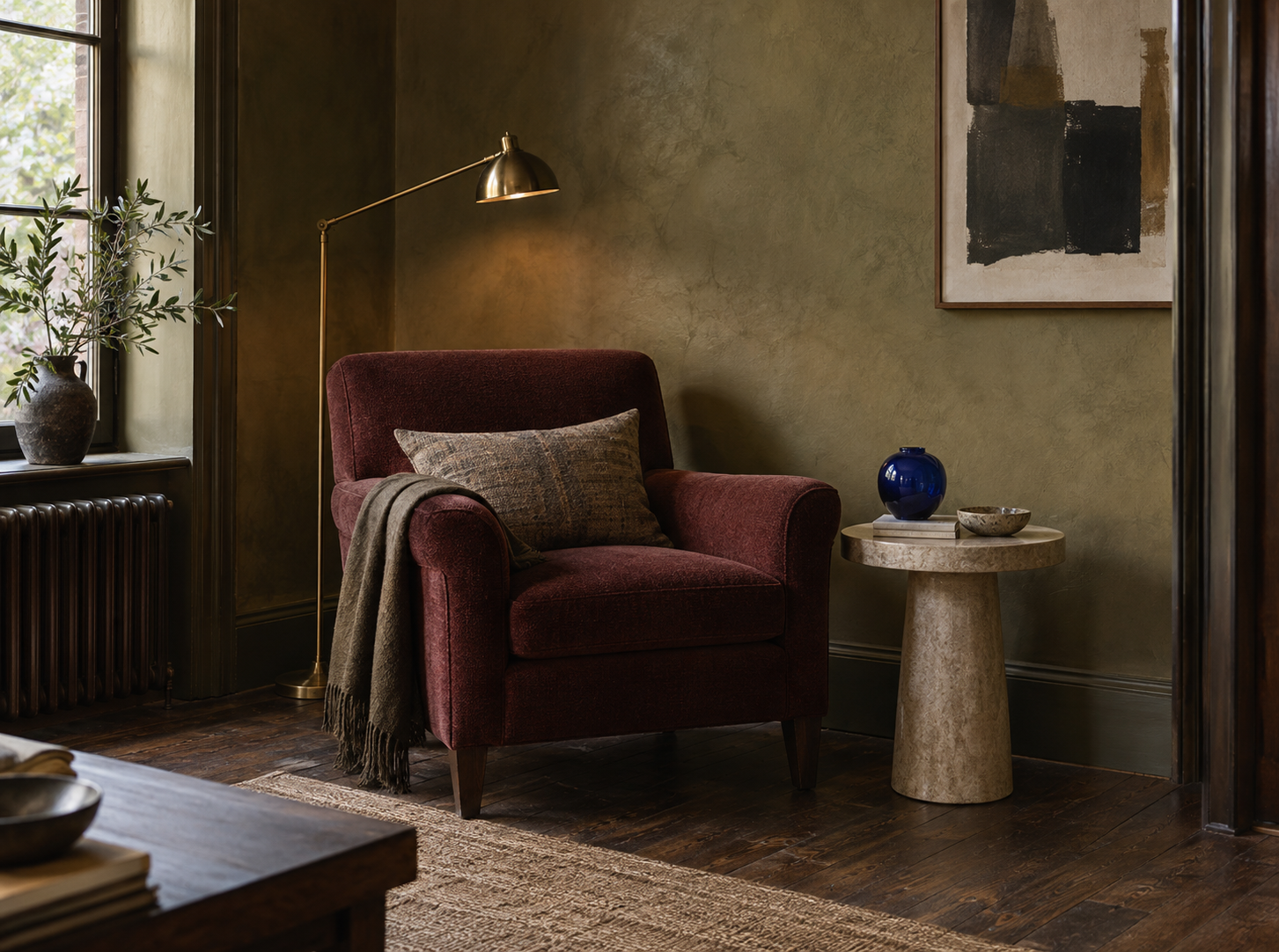
- a broad ground, such as warm stone, tobacco, parchment or a faded rug; - a structural color, such as olive, oxblood, aubergine or ink blue; - a smaller clear interruption, such as cobalt, coral or lacquer red.
Remember that wood, brass, stone and the worn field of a rug already count as color. A room may have a complex palette before a single painted wall or bright cushion is introduced.
Repeat the structural color at unequal scales. One chair, the darker note in a painting and a narrow line in a textile feel more natural than three matching accents. The purpose of repetition is recognition, not proof.
Let art organize the room
Art is often treated as the final layer. In an eclectic living room it can be the organizing force.
One large work can establish authority. A concentrated group can give a quiet wall density. A dispersed arrangement can connect furniture across a room. The choice should answer the architecture and the visual weight below it.
Do not choose art chiefly because it matches the upholstery. Look instead at scale, edge, spacing and the relationship between the work and nearby objects. A small drawing may need generous wall around it; a dense group may need simpler furniture beneath it.
Know when not to buy
The useful next purchase is not the most exciting object you can find. It is the object with a missing role.
Before buying, ask:
1. Is the room safe and functional? 2. Is the lead voice visible? 3. Does the room need more structure, more relief or one interruption? 4. Can rearranging, repairing or removing something solve that need? 5. If not, can you name the exact job the new object must perform?
That final sentence becomes the sourcing brief. “A lamp” is vague. “A tall, directional reading light with a dark line that repeats the fireplace and does not add another shade color” is a decision.
This is also the point at which vintage-versus-new becomes practical. Buy vintage where age adds material character and condition can be evaluated. Prefer new where hidden engineering, hygiene, exact performance, warranty or current safety standards matter more than patina.
The collected room is edited, not completed
A convincing eclectic living room does not look as if it arrived in one order. It also does not use “collected” as permission for every object to remain.
The work is to make difference legible: one lead voice, a handful of supporting relationships and enough relief for a surprising object to matter. When the room has that structure, adding less often produces more character.
Continue with the complete room method
The Eclectic Living Room: How to Mix Vintage and Modern Furniture, Color, and Art expands this method into a 77-page illustrated design book with twelve room studies, nine original diagrams and thirteen working sheets. See inside the book, or join the TAC newsletter for the founding-edition release note.