Culture ·
A table for four can begin with what you own.
Let a repeated line, a useful gap and one deliberate contrast bring familiar possessions into a different arrangement.
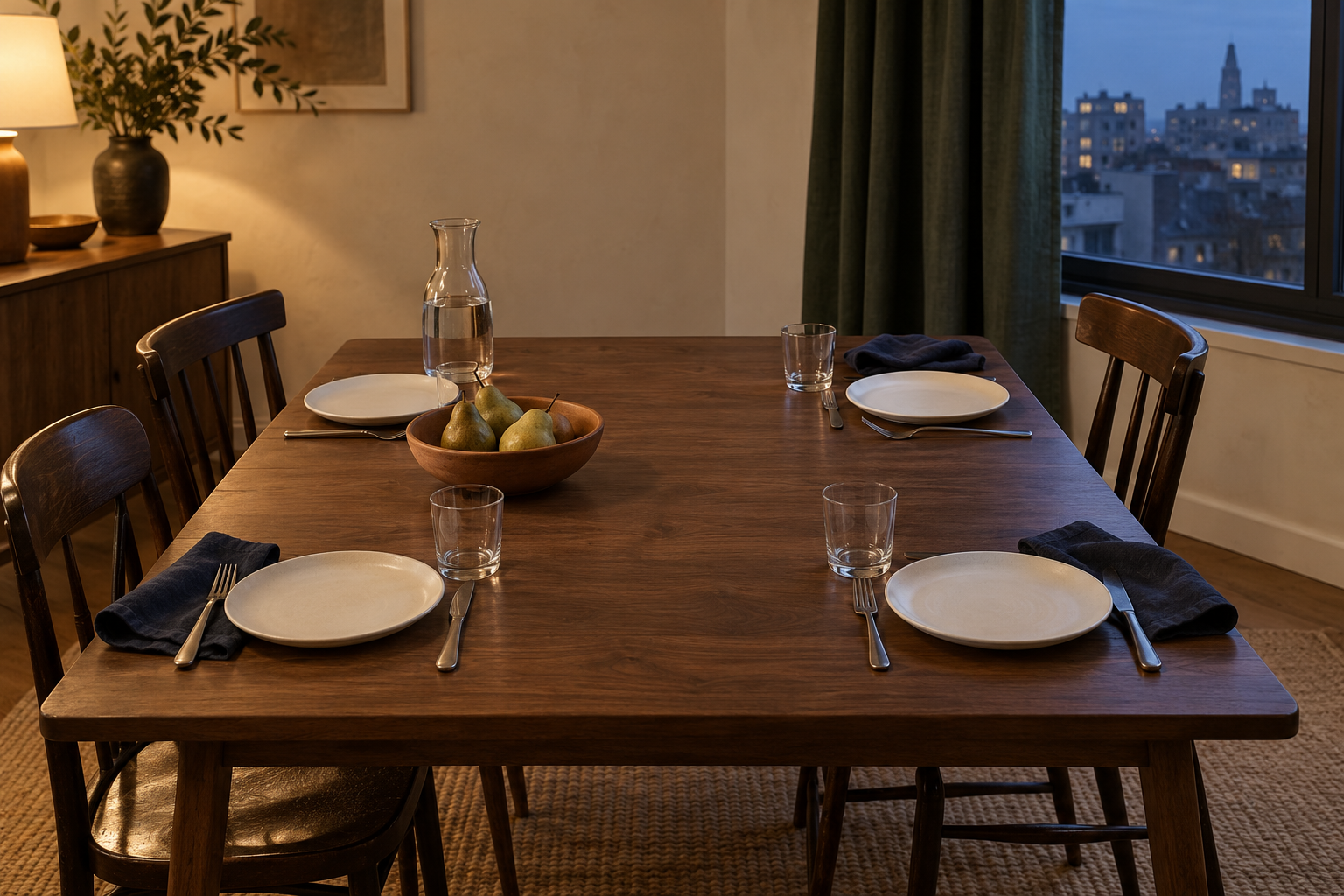
A table can look considered when the objects on it have a relationship, even if they arrived in the cupboard at different times and were never sold as a set. A dark rim on one plate might find an echo in a striped napkin, while clear glasses leave a patterned cloth enough room to be seen. The pleasure comes from noticing those connections and making them legible, rather than concealing every difference.
For a table for four, begin with a small arrangement exercise using the things you already serve with, and let the meal determine what earns a place. Treat this as an arrangement to try with your own table, adjusting the suggestions as you go. Your actual plates, chairs, serving dishes and guests will tell you more about the space than an inspirational image can.
Start with the meal and the objects it needs.
Bring out the plates, bowls, glasses and cutlery needed for the food you intend to serve, then give each person an ordinary usable place before adding decoration. A meal served in bowls creates a different picture from one that arrives on large dinner plates. Both can look beautiful, and neither needs an extra stack of dishes simply to achieve the layered appearance of a restaurant photograph.
Keep the serving vessels in the exercise from the beginning, even if the food will be added later, because they are among the largest objects competing for space. A generous central bowl may be the natural focus of the table. If it leaves no sensible place for water or a serving spoon, moving something to a nearby surface can be a better decision than trying to compress the arrangement until every object fits.
Choose one relationship that the eye can follow.
Look for a line, a material or a color already present in the things you have chosen, and repeat it where doing so feels natural. With cream plates and dark cutlery, a cloth containing a dark stripe might be enough to connect the setting. With several different glasses, repeating the same folded napkin can offer a shared rhythm while allowing their shapes to remain different.
The repetition should help the arrangement feel intentional without turning it into a demonstration of how many matching things you could assemble. Try leaving one element slightly outside the pattern, perhaps a green serving bowl among pale ceramics or an old wooden board beside polished metal. That contrast gives the eye somewhere to pause. If every item competes to be the accent, return to the piece you most wanted to use and simplify around it.
The empty space belongs to the setting too.
Sit in each chair and try the ordinary movements the meal will require, including lifting a glass, reaching for cutlery and receiving a serving dish. This is where the actual table should overrule the image in your head. An arrangement that feels crowded can often be improved by removing a decorative object or serving something from a sideboard, rather than replacing all the plates with smaller ones.
Leave a place for objects that arrive during the meal, such as the bread plate someone passes across or the serving spoon that needs to be set down. The table does not have to be visually complete before anyone sits at it. A little open surface gives the arrangement a way to accommodate the evening, which is a more useful form of generosity than a centerpiece that has to be relocated immediately.
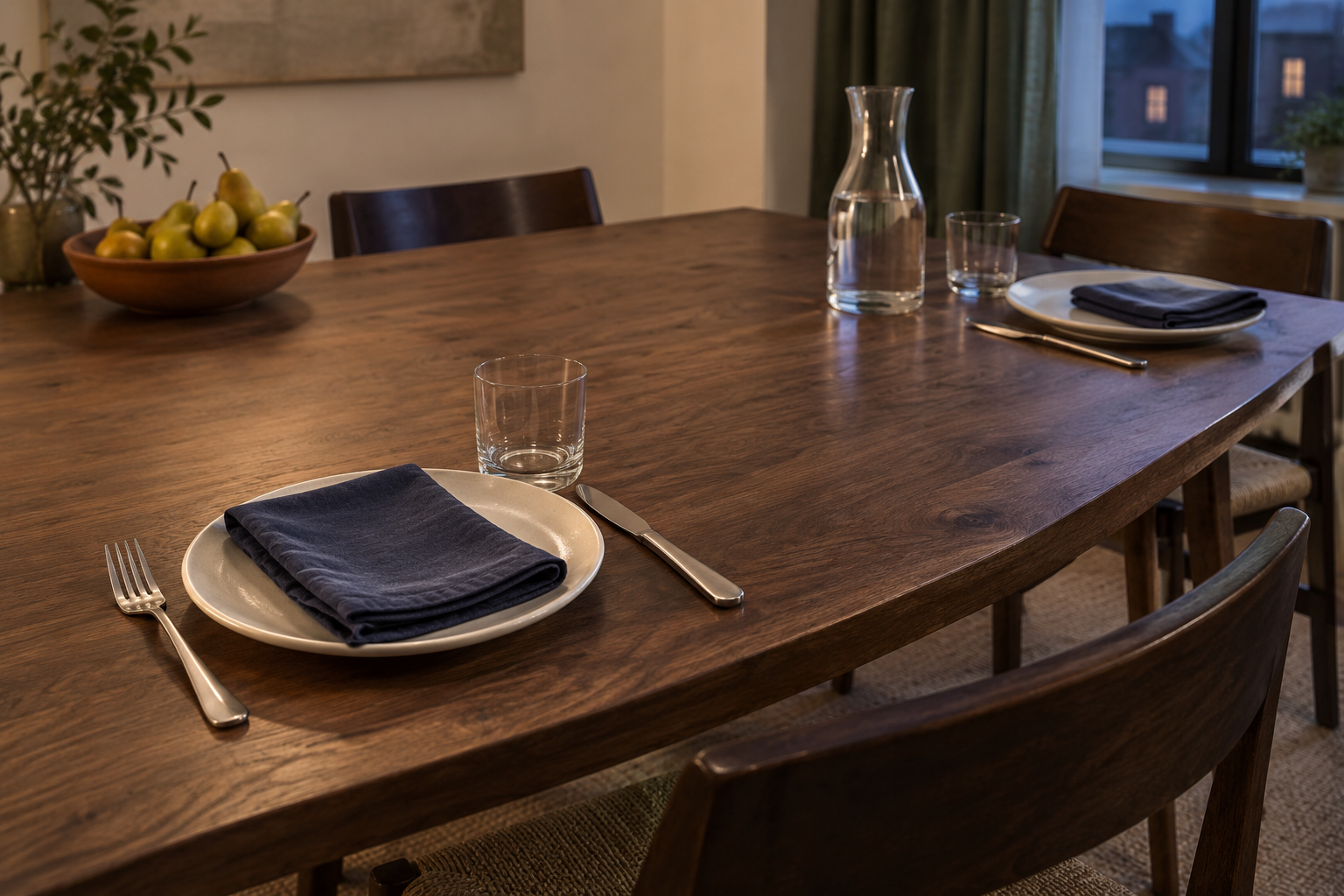
A textile can organize the scene without covering everything.
A cloth or napkin offers a broad area of color and texture, so its position can change the table more than an additional small ornament would. Try a full cloth when you want the surface to read as one field, or leave the tabletop visible and let individual napkins repeat across it. If you already own mixed linens, compare the relationships between their colors before deciding that difference is a problem to solve.
A simple fold is enough when the textile already has something to contribute, whether that is a woven stripe, a narrow border or a slightly irregular texture. Place it where it remains easy to pick up and where it does not conceal the part of the plate you wanted to show. The point of the fold is to make the cloth usable and the setting clear, rather than give each guest a small construction to dismantle.
A detail becomes more interesting when it has room to register.
Once the practical arrangement works, choose one detail worth noticing and let it carry more of the visual character than a collection of competing finishing touches. That might be the curve of a handle, the edge of a serving dish or the way a particular green changes beside cream. These are relationships you can assess with your own objects, without acquiring the same props as another person's table.
Look at the setting from the seat as well as from above, because the overhead view that makes a compelling photograph is only one way the arrangement will be experienced. If an object interrupts the view across the table, try moving it to the side. If the repeated color disappears once everyone sits down, it may already have done enough work in bringing the whole together; there is no obligation to amplify it.
The final adjustment can be a subtraction.
Before deciding that the arrangement needs something new, remove the element that seems least connected to the meal or the visual thread you chose. A table may become clearer when an extra layer of plates, a decorative vessel or an unnecessary place marker disappears. If a genuine gap remains, such as too few usable water glasses, identify that specific need and its storage space before turning it into a shopping list.
The most satisfying arrangement lets people use the table comfortably while making a familiar object newly noticeable through its relationship to everything around it. Coherence can come from a repeated edge, a considered color relationship and the room left between things. A successful table for four leaves space for the people who will change how it looks as soon as they arrive.